A successful driver in F1 can earn a lot of money, and reports showed in 2021, F1 earned more than $2 billion in revenue. F1 drivers receive additional bonuses through sponsorship opportunities and contractual agreements and endorsements rather than race prize money from F1. F1 has 20 seats, some people die before they even get a chance at formula 1, because even formula 2 is just as dangerous, the level of skill required here is 1 in hundreds of millions. So yes these drivers deserve every penny and maybe more, because none of these drivers should risking their lives for your amusement without being properly compensated.

$1M is way to low, I agree with focusing more on race placements maybe to control salaries, but a base salary I think is a must. Athletes are not slaves that has to give up they lives and time and devote everything for our enjoyment. The moment salaries are reduced in sports, racing and all these things revert to slavery. Because I can guarantee you would not devote all what you need to become good at any sport and expect minimum wage. That would be like me saying journalism is just a bunch of words put together in a few minutes or photographers are pointless because all you do is press a button. Stop reducing persons skill to just what you see on paper, when there is so much that goes on behind the scenes.

These people are human beings, not your puppets that you have at your beckon call. His bonus is paid by contractual agreements and sponsorships rather than from F1. Verstappen is ranked number two on the Forbes list of highest-paid Formula 1 drivers. With few Formula 1 driver salaries publicly available, Forbes relied on financial documents, legal filings and press leaks as well as conversations with industry insiders and consultants to compile this list.

Drivers typically receive a base salary plus bonuses for points scored or for race or championship wins, with the amount depending on the size of the team and the experience of the driver. Lewis Hamilton, who replaced Michael Schumacher at Mercedes in 2012, has become an icon on the same level as his predecessor. The 36-year-old signed a two-year contract extension with Mercedes this summer, following up on a three-year, $140 million deal in 2015 and a two-year, $100 million extension in 2018. He is also the founder of X44, a team in the new off-road electric-SUV racing series Extreme E.

Okay, so it's no secret that F1 drivers can earn a lot racing for some of the championship's top teams. Whether that's expensive deals to sign them or bonuses and sponsorships, it's not really unusual to see them become millionaires. If they win one race, they get X dollars; if they win two, double it. If they win the Indianapolis 500, that's usually where the biggest bonus comes — even more so than winning the series championship.

Sometimes, that bonus will come from the team, but it often comes from a team partner or sponsor. As a hypothetical, if Scott Dixon won the 105th running of the Indianapolis 500 this year, PNC Bank might pay him a bonus as a reward for all of the added exposure. Although occasionally pay drivers are labelled as "unworthy" for an F1 seat, many of the pay drivers in F1 today come with occasional success in their individual races in lower formulas. Maldonado would cement his place in Formula One history with a win at the 2012 Spanish Grand Prix as the first Venezuelan to win in F1 with what became the only pole, podium, and win of his career.
It was also the first win for Williams since 2004 and their last as of 2021. NFL has hardly any interest outside of the US, despite numerous attempts to spread it to Europe. Whereas F1, football, tennis, etc, are played and watched around the globe.

The stars of those sports are known world wide and earn accordingly. There are only 20 F1 drivers, there are hundreds of NFL players and I couldn't name one. There's no games for retired players, there are no games for anyone who doesn't play at college and then become a professional. Formula One group placed a cost cap on each team in 2021 of $145 Million throughout the season. This cost cap only applies to performance-based costs like building, optimizing engines, and car structuring, including salaries paid to engineers and other staff.

The cost cap also applies to branding, bonuses, hotels, and travel expenses. Formula One driver salaries are not affected by the cost cap, and teams can pay their drivers as much as they like. Formula One drivers do not receive prize money; their teams pay their salaries. Generally, the drivers or the teams do not disclose their total earnings.

The highest-paid F1 driver is Lewis Hamilton, who earned $65 million from his contract with Mercedes. Just like NASCAR racing Formula one also offered pit crew services for drivers and teams. Millions of dollars paid to the pit crew staff's each year for their efforts during the race. F1 Pit Crew Members Salaries reported in year 2015 for the first time. If Hamilton becomes an eight-time World Champion soon, there's a high likelihood that the statistically greatest driver of all time could become the richest as well.

The budget cap introduced this season only affects performance-related costs, not driver salaries. This means the top teams can spend big money to keep their number one drivers on board. This may be done to gain on-track experience or to live the lifestyle of a driver in a particular series when one's talent or credentials do not merit a paying ride. Alternatively, said person is also called a ride buyer or a rich kid in the United States, a gentleman driver in sports car and GT racing and a privateer in Australia.

Hamilton, who has four wins through ten races, still has time to overtake Verstappen, with the gap in the standings a mere eight points and 12 races remaining on the schedule . This is where NASCAR drivers can either make or break, particularly new ones with lower salaries. The higher a driver places in each race, the more money they get to take home. Depending on the race, drivers who earn a top 3 finish can make north of $1 million, although in most cases the teams will take at least a 50% cut of the earnings.

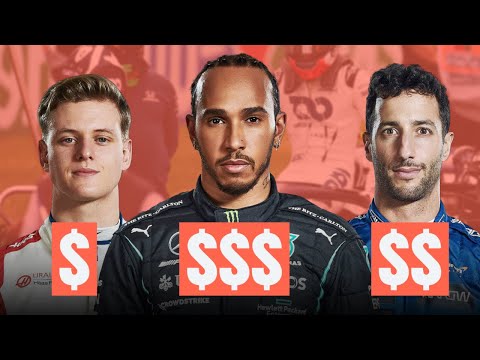
Still, drivers can pocket $500,000 or more for a single race, and there are 38 chances in each season for them to earn some of that cash. True, some drivers pay to race, but that compounds the divide between the top three teams and the rest. The solution is for driver earnings to be included in budget caps on the basis that they are performance differentiators, which would in turn release more funding for staff and technology by driving down driver costs. Leading the pack is Mercedes superstar Lewis Hamilton, who is on pace to earn $62 million on the track in 2021. That figure includes a $55 million base salary—more than double what his closest competitor is guaranteed—as well as a projected $7 million in bonuses for race wins. Drivers earn money through a combination of salary, bonuses and sponsorship.

The better a driver performs, the more they can earn through bonuses and sponsorship. Some drivers even 'pay' for their racing seats by bringing in sponsorship revenue to their teams. Leading the field is Lewis Hamilton (Mercedes-AMG), with a reported annual salary of $30 million. At the end of the 2020 season, Hamilton was reportedly earning around $40m per year, but his new deal (a one-year contract with the option to extend into 2022) saw him take a reduced salary.

Despite him being a seven-time champion and rewriting the sport's record books, it wasn't enough to warrant a hefty paycheck. And with Williams driver George Russell waiting in the wings to take over, Hamilton had little choice but to agree to the new deal. Because of this the rules on driver changes were subsequently tightened. Being paid an estimated $40-$50 million to drive an F1 race car is clearly outrageous, especially considering that winning an F1 race is not solely nor mostly dependent on the driver.

Consider the fraction of Hamilton's yearly salary that Bottas gets, and Bottas still gets some wins, the disparity between those two drivers, on the same team, is quite ridiculous. The difference in salary is a factor in how the team mates view each other, and that affects the racing. Still, the drivers' salaries should continue to make up for the marketing gap. Formula 1 drivers earn the bulk of their money through team salaries, but that's not their only revenue source. Many driver contracts include performance-related incentives to encourage them to place as high as possible. Drivers also earn funds from sponsorships and brand endorsements.

Most of the contracts of Formula 1 drivers include performance-based bonuses wherein they will get an amount based on winning a race and also scoring points over and above the threshold level agreed mutually. Most F1 drivers do not boast about their earnings however they don't stop the press from speculating either. Formula 1 isn't as shy about its petrochemical and tobacco ties, its aristocrats and oligarchs, its demonstration of what bored money buys. The centrality of cash isn't masked with queasy invocations of meritocracy—it is thrillingly explicit. The drivers are generally young and handsome, and many grew up wealthy. The sport has a long history of "pay drivers," whose seats in Formula 1's two-person teams are bought—either with their own money, or with that of an interested sponsor, usually from their home country.

In the case of the Canadian driver Lance Stroll, who races for Aston Martin, his billionaire father bought the whole team. The 31-year-old Australian driver appears in the top 5 despite cutting his salary by almost half after leaving Renault to join McLaren. Ricciardo will now have a base salary of 11.6 million euros for 2021, when in 2020 he received 20 million . According to News, Ricciardo could earn much more due to the bonuses included in his contract, such as 1 million euros for each race he wins , in addition to 400 thousand euros each time he adds points. For this reason, the Australian has strong chances of earning much more money. Pay drivers are also common in stock car racing and are very prevalent in development series such as the Xfinity Series and ARCA Racing Series.

There are also several pay drivers competing at the Cup level including Matt Tifft and Paul Menard, the son of home improvement tycoon John. Menard had some success with a victory at the Brickyard 400 in 2011 and a Chase for the Sprint Cup appearance in 2015, while medical issues halted Tifft's racing career in 2019. In recent years, two particular teams that notoriously made headlines for hiring pay drivers were Racing Point and Williams. After Racing Point was purchased by a consortium led by Lawrence Stroll, his son Lance took over one of the team's seats in 2019. Kubica himself was then labelled with the tag when he took over from Sirotkin as his own seat was funded by a large sponsorship deal from Orlen. How much an F1 driver, or any athlete in any sport, gets paid should be based on how much the team owner/s and the athlete can negotiate and agree.

Only the person/company how much any athlete is worth to their team. That said, as an organization, like any sport, F1 could and should consider the great disparity of salary between drivers in each team. I base that on the prevailing thinking that any employee should be paid an equal salary for equal work requirements.
As with any job, every employee is expected to "produce" for the company. In racing the product of the driver/employee is race position outcome, along with meeting the other work requirements of testing, media appearances, and any other agreed to work requirements. Because there is also a salary floor, teams at the bottom of the series can exploit that because of quirks that mean that teams have to pay the salaries of injured players. Plus, the principals are deeply secretive, with most members of the racing fraternity unwilling to discuss contracts, salaries, or sponsorship deals.

How Much Do Formula 1 Drivers Make Per Year Top drivers like Lewis Hamilton or Max Verstappen can earn tens of millions through their team salary but that's not their only source of income. Personal sponsorship can play a huge role in what an F1 driver makes, with Hamilton earning an estimated £8.7 million per year in endorsements. Just in Formula One alone, the disparity between those at the front of the grid and those at the back can be enormous. For example, five-time world champion Lewis Hamilton earns in excess of £40 million a year at Mercedes, while rookie George Russell, who drives for the struggling Williams team, receives a relatively paltry £140,000. Many drivers receive such small payments and have to rely on personal sponsorship deals to boost their income.

Sometimes teams will offer junior drivers contracts and pay them to race. Other times you will find that a driver buys their way into a team through an extremely rich relative or an extremely successful sponsorship . These are racing series like the Toyota Gazoo Racing Series in New Zealand.

These series run during the December, January and February months. This is great because while other drivers are in between seasons, you will be racing. It will give you a head start when the season starts or keep you active and gaining experience in between your seasons.

Lando Norris is one driver who participated in this exact same series and picked up some Super Licence points with his championship win. He's the one who hold most important duties regarding to pit stop. The top racing teams in Formula 1 paid expensive salaries to their pit crew staff. Some teams paid contract based salaries to the staff members.
There are also "perks." Some drivers' contracts will include a motorhome as well as expenses (fuel, cleaning, etc.) to maintain it. Team and now series owner Roger Penske has been known to "take care of" his veteran drivers in lieu of paying them premium salaries, one source said. That can mean any number of things, but includes helping set up his drivers with car dealerships or making other business arrangements where they can earn money away from the track. They might earn some of their annual compensation in salary, but the rest is determined by a number of factors. As an example, if a driver brings $2 million worth of sponsorship, he or she might earmark $500,000 for themselves as salary. However, if it's a better team, and that driver really wants to race with that program, she or he might take less out of that $2 million in order to do so.

Unlike most professional sports in the United States, where agents and even teams regularly release contract figures, Formula 1 is still a rather closed society in that regard and actual figures are not released. In F1, drivers typically work for a base salary plus bonuses for wins and place in the final standings. To make it into F3 and F2, you need to have a solid budget. That is usually fed by a combination of financial support from your family, a suite of sponsors or a link to a Formula 1 driver academy.

Those who bring money, either personally or through a backer, are often called pay drivers and there are negative connotations there. F2 is designed to deliver close racing but also prepare drivers for F1, so the cars need to have a certain level of technology and challenge so the step up isn't too large. So the focus is on reducing operating costs and increasing the core elements of a race team. That means all teams use a chassis made by Dallara, and a Mecachrome power unit.

Saying they are getting paid for a "…couple hours of sweat time…" is beyond insulting. The physical and mental strain drivers experience while driving an F1 car are is beyond the limits of what most human beings are capable of. This is yet another example of a press member who because he has covered the sport for so long somehow thinks he knows what it is to actually drive in Formula 1…he DOESNT. He would be wise to remember he has a job because of these drivers. He along with 100s of others make their money because of what these drivers do week and week out. Given Hamilton's obvious and amazing racing abilities, I understand why he is very highly valued by MB, or any team that may want him.

Still, I don't view his abilities and performance outcomes as being 5 times more valuable than Bottas's. And yet, that is the difference between Hamilton's $40 million per ear and Bottas's $8 million per year. Would Mercedes Benz really lose 5 times more races if both Hamilton and Bottas were paid the same yearly salary? Vettel's yearly salary is shown as $30 mil and LeClerc at $10 mil.


No comments:
Post a Comment
Note: Only a member of this blog may post a comment.